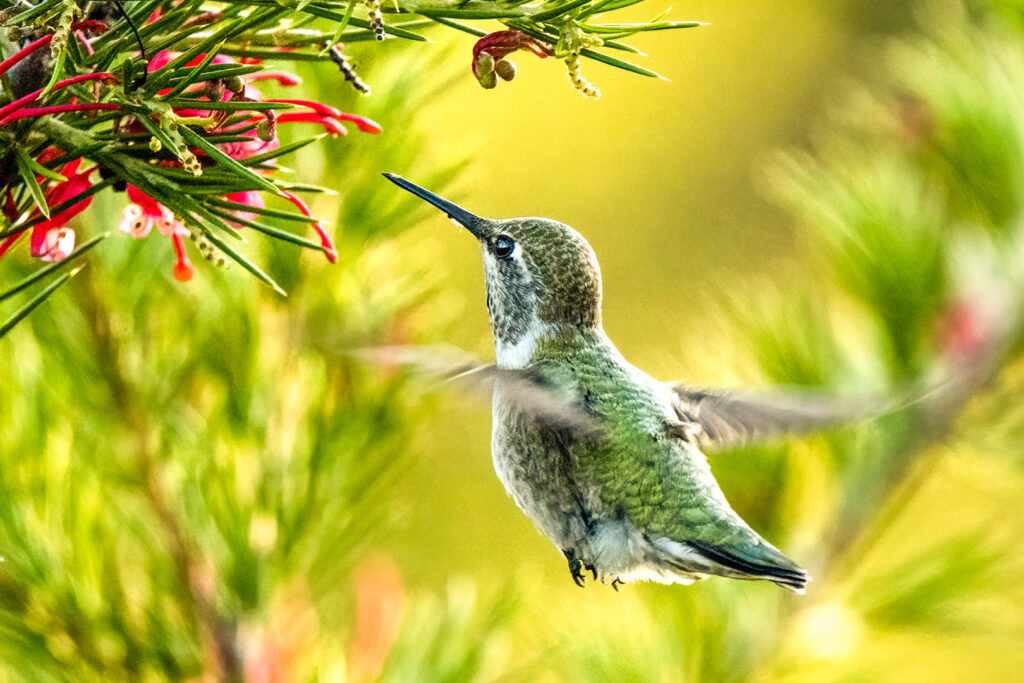
Hummingbird
Trochilidae
Appearance
In British Columbia, we most often see Anna’s, Rufous, Calliope, and Black-chinned hummingbirds. There are differentiating features about these birds, but all hummingbirds share similar qualities. They are small and light birds, ranging from 3 to 5 inches in length and 2 to 5 grams. They frequently exhibit vibrant hues across the rainbow from reds to greens and blues to oranges.
Range & habitat
Hummingbirds are found throughout North and South America. In British Columbia, there have been nine species spotted, and four of these can be found regularly. These birds are migratory and often spend winters in Mexico.
reciprocal relationship
Hummingbirds act as important pollinators in their ecosystems. Their definitive long, slender noses allow them to reach deep into flowers to retrieve nectar. Traveling from flower to flower, collecting this nectar, allows them to pollinate many flowers. There are even some flowers that only hummingbirds pollinate! Without these vital pollinators, we could lose many flower species. While pollinating these flowers, seeds from the plants stick to the bodies of hummingbirds and allow plants to spread to new regions, contributing to the great biodiversity of our planet!
Hummingbirds are omnivores! They are best known for their role as pollinators; however, to sustain their rapid heart rate and movement, they have to eat many insects as well. They play a vital role in managing our fruit fly, mosquitoes, and spider populations, amongst others.
They are very important beings in our ecosystems. However, they are also some of the most prone to environmental changes. Hummingbirds are threatened by disease spread, pesticides, climate change, and, most importantly habitat loss. The destruction of forests and grasslands has led to a decline in available habitat for hummingbirds to thrive in. ,
Hummingbirds are omnivores! They are best known for their role as pollinators; however, to sustain their rapid heart rate and movement, they have to eat many insects as well. They play a vital role in managing our fruit fly, mosquitoes, and spider populations, amongst others.
They are very important beings in our ecosystems. However, they are also some of the most prone to environmental changes. Hummingbirds are threatened by disease spread, pesticides, climate change, and, most importantly habitat loss. The destruction of forests and grasslands has led to a decline in available habitat for hummingbirds to thrive in. ,
More Information
If you belong to a First Nation with a story or piece of information not represented here and you would like to share more about this species, please email us at education@sierraclub.bc.ca.
Photo Credit
Mya Van Woudenberg