Common Bladderwort
Utricularia vulgaris
Appearance
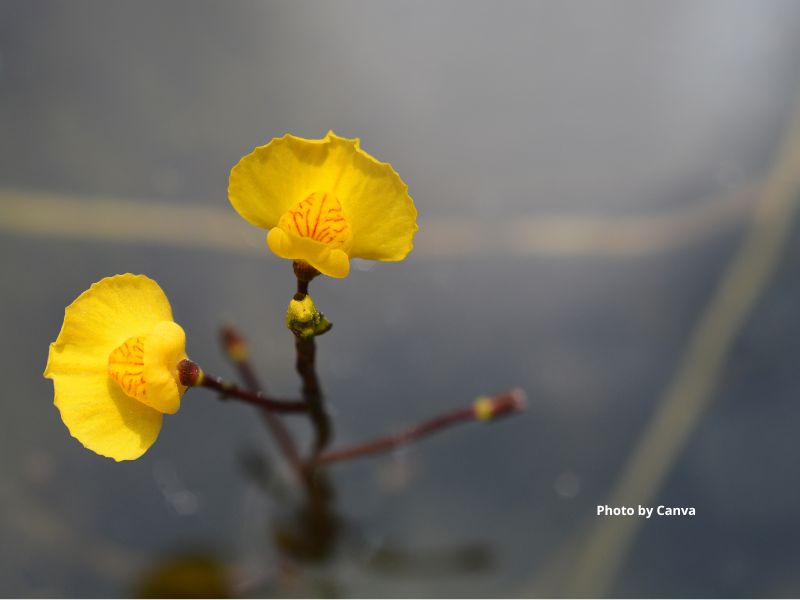
Common Bladderwort is a free-floating aquatic plant that is most notable by its signature yellow flowers that pop up out of the water. Underneath the surface, this plant has a network of divided stems containing small bladders that create a vacuum.
Range & Habitat
Common Bladderwort can be found in lakes, ponds, and marshes across Canada, including Alberta and the Lake Superior region.
Reciprocal relationships
Bladderworts are the speed demons of the plant world—their tiny underwater traps snap shut in less than 1/35 of a second! Instead of roots, it has finely divided stems with small bladders that create a vacuum to suck in tiny aquatic organisms like insect larvae and zooplankton. This adaptation allows bladderworts to thrive in nutrient-poor waters.
Ecologically, they help control populations of microscopic organisms and provide shelter for aquatic insects and even food for waterfowl. Their presence signals a healthy wetland ecosystem, which is vital for water filtration and carbon storage. The small bladders of this plant create a vacuum to suck in tiny aquatic organisms like insect larvae and zooplankton. This adaptation allows bladderworts to thrive in nutrient-poor waters.
Ecologically, they help control populations of microscopic organisms and provide shelter for aquatic insects and even food for waterfowl. Their presence signals a healthy wetland ecosystem, which is vital for water filtration and carbon storage.
Ecologically, they help control populations of microscopic organisms and provide shelter for aquatic insects and even food for waterfowl. Their presence signals a healthy wetland ecosystem, which is vital for water filtration and carbon storage. The small bladders of this plant create a vacuum to suck in tiny aquatic organisms like insect larvae and zooplankton. This adaptation allows bladderworts to thrive in nutrient-poor waters.
Ecologically, they help control populations of microscopic organisms and provide shelter for aquatic insects and even food for waterfowl. Their presence signals a healthy wetland ecosystem, which is vital for water filtration and carbon storage.
more information
If you belong to a First Nation with a story or piece of information not represented here and you would like to share more about this species, please email us at education@sierraclub.bc.ca.
photo credit
Canva